
EMPOWER: Using AI to Harness Electronic Health Records for Empowering Cancer Patients

Active
5/2025 ⟼ 12/2028
Why
Czech oncology patients navigate a fragmented information landscape which is difficult to contextualize: national portals, hospital websites, patient-organization content, or printed leaflets. In effect, the system asks the sickest individuals to be the most efficient researchers. Access to information does not automatically translate into understanding, especially for patients with lower health or digital literacy.
What we are building
Within EMPOWER we are designing, deploying, and studying Onkorádce, an AI assistant for oncology patients and the public. It is envisioned as a trustworthy, human guide helping patients understand cancer, their diagnosis, treatment, and the care system — anytime, with the confidence of verified information.
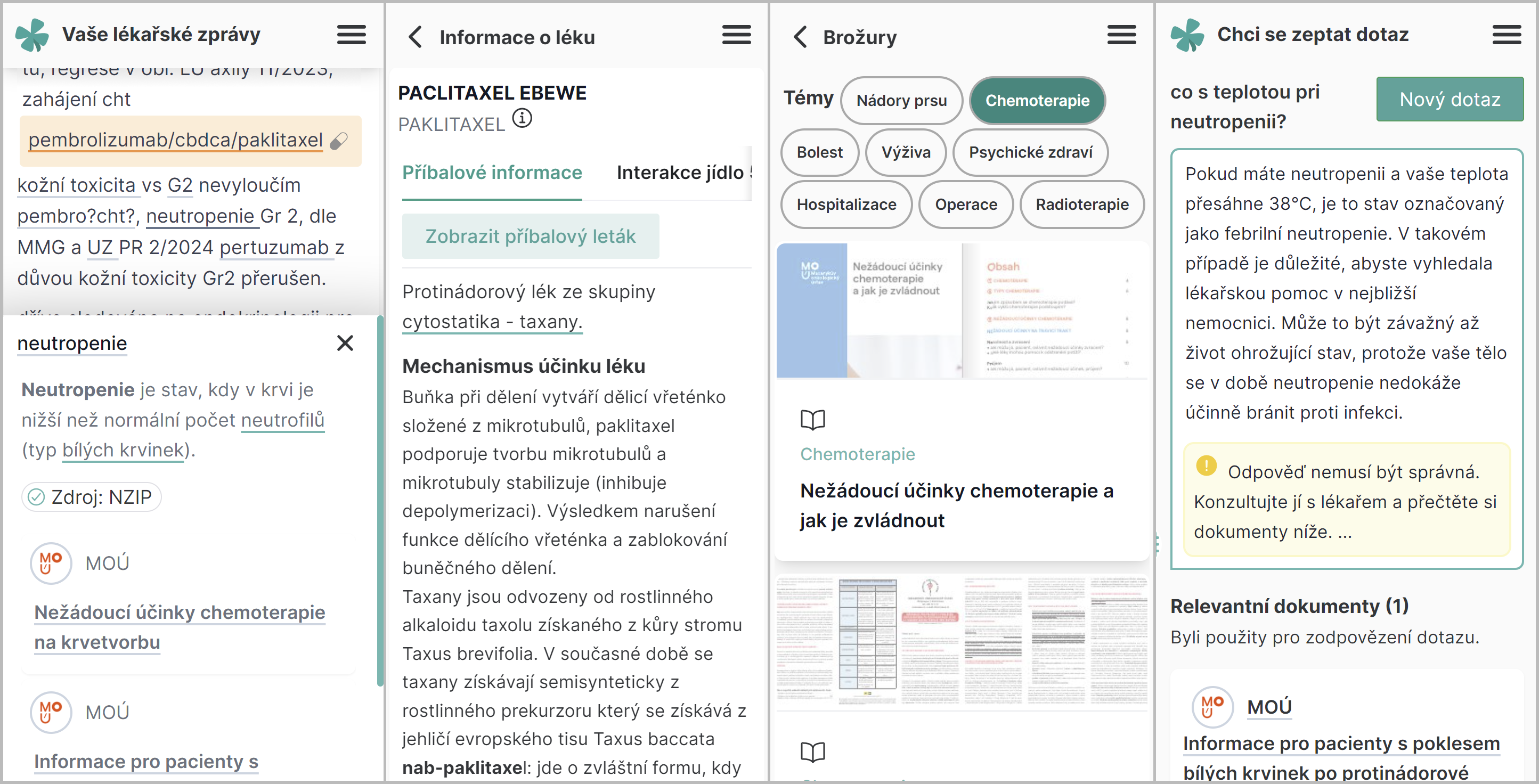
The assistant combines three lines of work:
- Grounded language models — answers are generated against a curated knowledge base of authoritative Czech oncology sources, so responses stay traceable to their origin rather than relying on a model's parametric memory alone, using state-of-the-art RAG application to oncology.
- Personalisation from clinical and interaction context — tailoring information delivery to a patient's situation and stated needs, learned from their interactions with the assistant and, where appropriate, from their electronic health records; and we research state-of-the-art models for extracting clinical events from Czech clinical notes.
- Intuitive interfaces — conversational and search-like interaction designed with, and for, patients who are not digital natives.
Project website: onkoradce.cz — the public site of the assistant.
How we study it
EMPOWER is using research-through-design and participative design methodologies: the assistant itself is the research instrument. Deployment is staged to ensure safety of patients, beginning with offline evals and moving into progressively richer real-world settings inside the hospital, with clinician oversight throughout. Across these stages we investigate four questions:
- How do we translate established patient information needs into the design of a patient-facing AI assistant?
- How can such a system be architected and constrained to deliver clinically reliable, personalised, and understandable information?
- How do patients actually interact with the assistant in real clinical settings, and where does it fail them?
- To what extent does its use change patient-reported empowerment and satisfaction with health information?
Team and partners
EMPOWER is a collaboration between MUNI and the Masaryk Memorial Cancer Institute (MMCI) in Brno. The multidisciplinary team of roughly 17 people includes AI researchers from our group with oncologists, clinical psychologists, behavioural researchers, staff of MMCI's Information and Education Center, healthcare legal-compliance experts, and cloud-infrastructure partners. Our group coordinates the consortium and delivers the bulk of the R&D work, under PI doc. Vít Nováček.
Funding
The project is supported by the Ministry of Health of the Czech Republic under the Healthcare Applied Research Support Program 2024–2030, grant NW25-09-00465.